Follicular study and fertility scans: what each scan tells you
A follicular study is a series of ultrasound scans that track a growing follicle until it is ready to release an egg. Fertility scans are also used to count follicles, check the uterine lining before transfer and confirm early pregnancy.
- Type
- Mostly transvaginal
- Time
- 10–20 minutes
- Pain
- Usually none
- Uses
- Baseline, tracking, lining, early pregnancy
What is a follicular study?
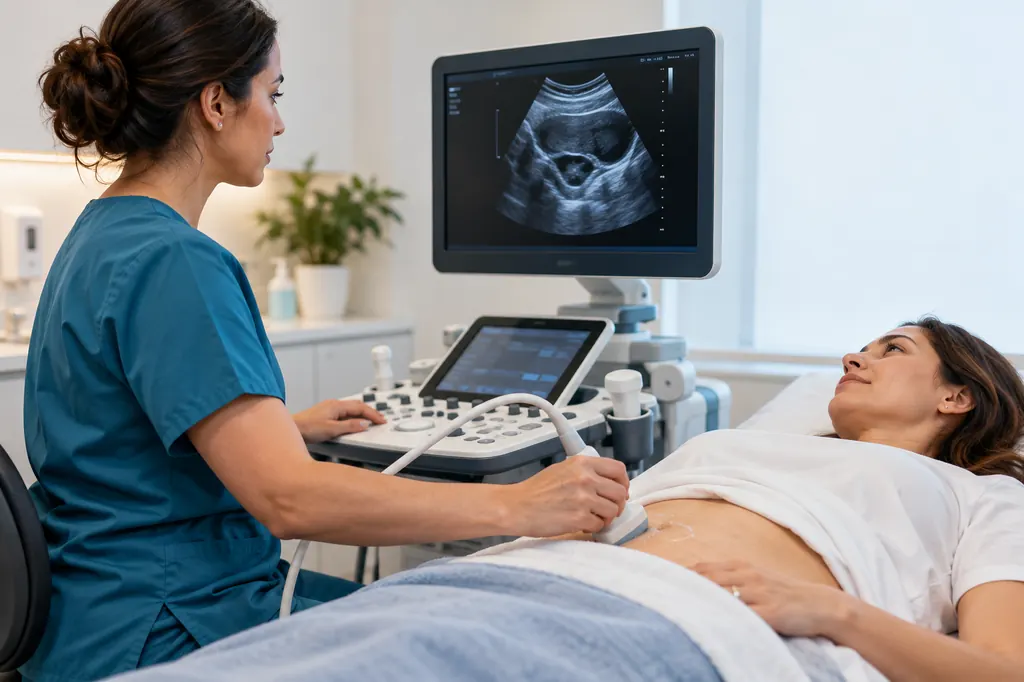
Ultrasound uses sound waves to create images, with no radiation. In fertility care the transvaginal route is preferred, because the probe sits close to the ovaries and uterus and gives a much clearer picture than an abdominal scan.
Scans are repeated throughout treatment because they answer different questions at different times: how many follicles are available, how they are growing, when to trigger ovulation, whether the lining is ready, and finally whether a pregnancy is developing normally.
Who Fertility scans may help
- Anyone starting fertility tests
- Ovulation tracking for timed intercourse or IUI
- Monitoring during IVF stimulation
- Lining checks before embryo transfer
- Early pregnancy scans after treatment
Good to know. A scan shows structure, not tube openness — a separate tube test is needed for that.
How to prepare
- For a transvaginal scan, empty your bladder just before.
- Wear comfortable, two-piece clothing.
- Note the first day of your last period — the timing of the scan matters.
- Ask for a chaperone or a female sonographer if you prefer.
Follicular study and fertility scans, step by step
Baseline scan
On day 2–3 of the cycle, checks the ovaries, antral follicle count and uterus.
Follicle tracking
Repeat scans every few days measure follicles as they grow.
Lining check
The thickness and pattern of the endometrium before transfer.
Early pregnancy scan
Confirms the pregnancy is in the uterus and checks the heartbeat.
Understanding your results
- Antral follicle count
- Small follicles on day 2–3; higher counts usually mean more eggs with IVF stimulation.
- Follicle size
- Follicles around 17–22 mm are usually mature enough for a trigger injection.
- Endometrial thickness
- Many clinics like the lining to be at least about 7 mm before transfer, along with a suitable pattern.
- Uterus and ovaries
- Can show fibroids, polyps, cysts or features of PCOS.
What to expect on the day
- An empty bladder is usually best for a transvaginal scan.
- You can ask for a female sonographer or a chaperone.
Benefits, limitations and risks
Benefits
- Safe, with no radiation
- Quick and usually painless
- Guides timing of treatment precisely
Limitations
- Cannot show whether tubes are open without a special contrast test
- Small polyps or scarring may need hysteroscopy to confirm
Risks and side effects
- Ultrasound is considered safe and uses no radiation.
What the results mean for treatment
Scans don't change success directly, but accurate tracking helps time IUI, trigger injections and transfers correctly.
Alternatives to discuss
What affects the price of a fertility scans
- Number of scans in a cycle
- Specialist scans such as 3D ultrasound or HyCoSy
Before you book, ask the lab or clinic for the price of each test, whether repeat tests cost extra, and how soon results will be ready. Prices vary between labs and cities.
Questions to ask your doctor
- What is my antral follicle count?
- How many scans will this cycle need?
- Is my lining ready for transfer?
Frequently asked questions
What is a follicular study?
A series of transvaginal ultrasound scans, usually from about day 9–10 of the cycle, that track a growing follicle until it is ready to release an egg. It is used to time intercourse, IUI or a trigger injection.
How many days does a follicular study take?
Usually three to five scans spread over about a week in the middle of the cycle, until ovulation is seen or expected.
Is a transvaginal scan painful?
It may feel a little uncomfortable but should not be painful. Tell the sonographer if it is.
What is the antral follicle count?
The number of small follicles seen on a day 2–3 scan. Together with AMH it estimates how the ovaries may respond to IVF medicines.
Can ultrasound check if my tubes are open?
Not a standard scan. A special scan with contrast (HyCoSy) or an X-ray test (HSG) is needed.
Is a 3D ultrasound better?
3D scans can give clearer views of the uterine shape, helpful for suspected septum or other abnormalities. They are not needed for routine tracking.
Can I have a scan during my period?
Yes. Baseline scans are usually done on day 2–3, during bleeding.
Not sure if Fertility scans is right for you?
See a fertility doctor at an IVF Pulse centre in Bangalore: Kalyan Nagar (HRBR Layout), RR Nagar and Rajajinagar (at Tamara Hospital). Nothing to pay when you book, and you can change the time on WhatsApp.